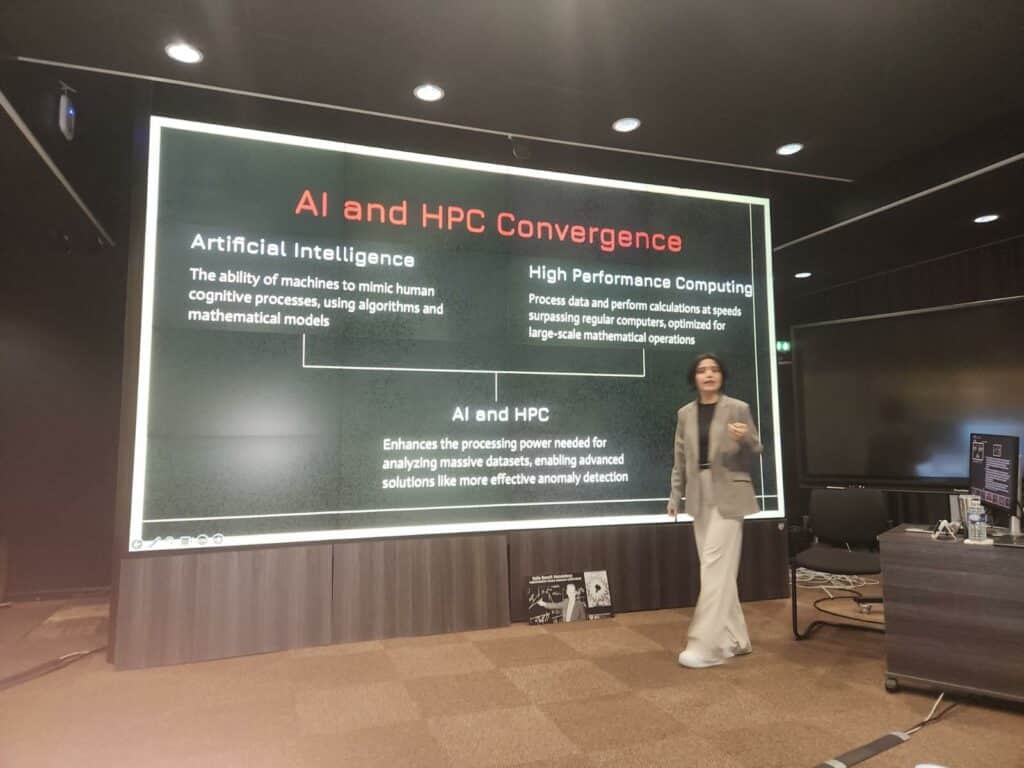
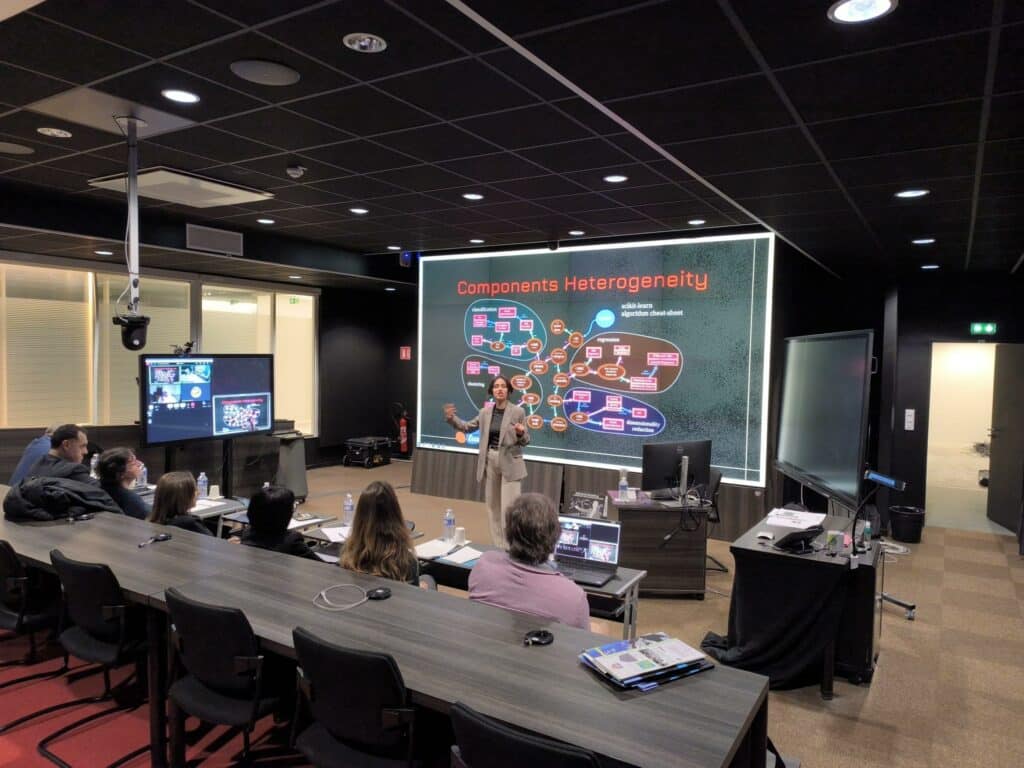
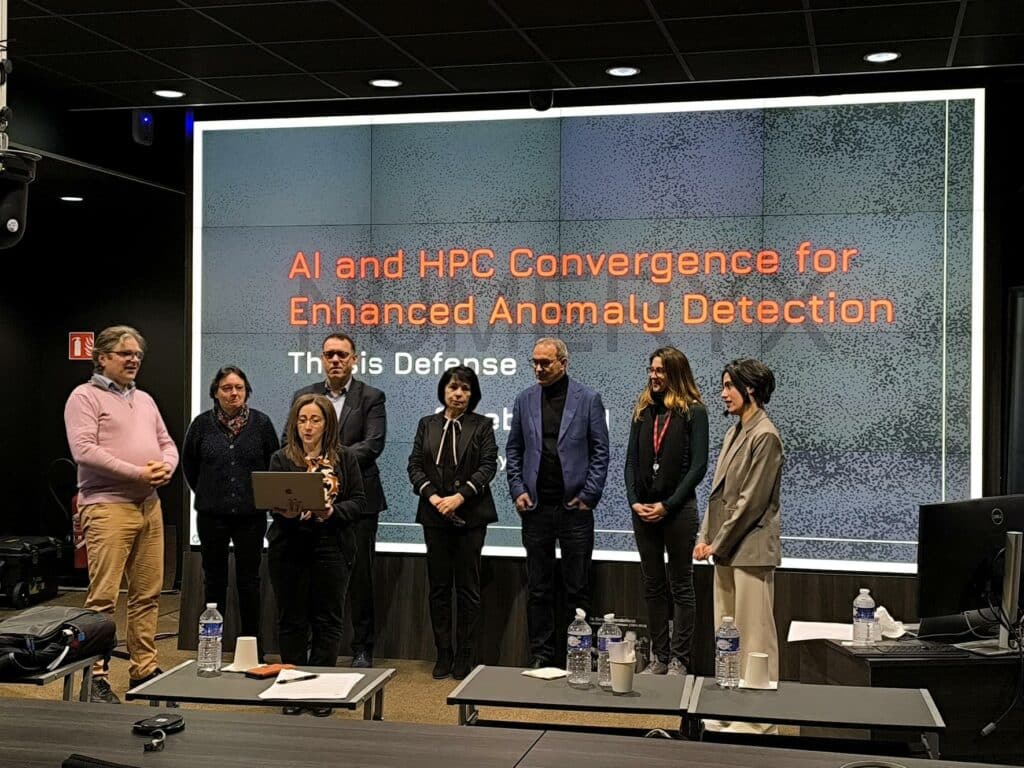
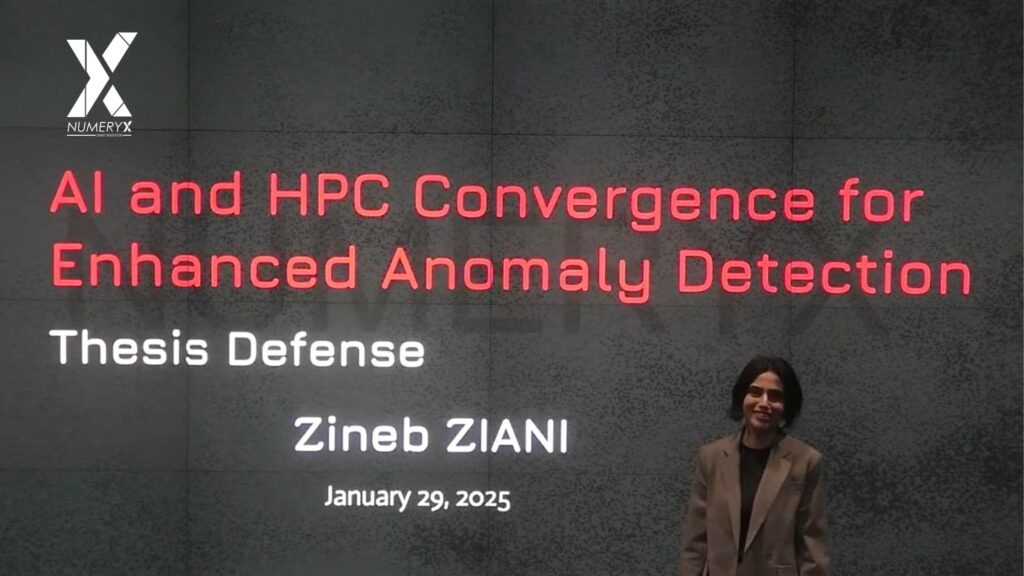
On 29.01.2025 – Maison de la Simulation at the CEA Paris-Saclay, Zineb ZIANI, AI, HPC & Cybersecurity researcher for 3 years at NUMERYX, defended her thesis entitled “AI and HPC Convergence for Enhanced Anomaly Detection“.
What is the subject of her research in AI, HPC & Cybersecurity?
Anomaly detection, a branch of AI, aims to identify instances or patterns in data that deviate from the norm. This capability is essential in various sectors, including finance, where it helps identify fraud; healthcare, where it detects abnormal conditions; and predictive maintenance, where it anticipates equipment failures. In cybersecurity, anomaly detection makes it possible to identify suspicious behaviour and helps prevent intrusions by analysing unusual patterns in network traffic.
Existing techniques, such as statistical methods like Grubbs’ test, as well as methods based on clustering, machine learning and deep learning, have limits in terms of accuracy and efficiency, particularly when dealing with complex anomalies or dynamic, high-dimensional environments. Generalising these methods to detect various types of anomalies remains a challenge, often requiring adaptations or combinations of approaches to improve performance.
Ensemble learning techniques, such as Bagging, Boosting and Stacking, can also offer interesting solutions for anomaly detection. These methods, traditionally used to improve the accuracy of classification and regression models, provide more general models that improve the robustness, flexibility and generalisation of base models. However, they do not always provide very good accuracy. Moreover, they require significant computing power to process large volumes of data in real time, a crucial factor for anomaly detection platforms in production, particularly in environments such as cybersecurity, where attacks constantly evolve and become more sophisticated.
The aim of this thesis is to combine artificial intelligence and high-performance computing to ensure efficient, fast and scalable anomaly detection.
To do so, we apply the Unite and Conquer (UC) approach to ensemble learning methods, in order to develop a framework optimised for continuous online training, ensuring immediate, fast and accurate threat detection.
The Unite and Conquer (UC) approach and the collaborative approach
The UC approach, initially developed in linear algebra, involves several iterative methods (co-methods) collaborating to solve a given problem more efficiently than each co-method individually. This collaboration, which consists of sharing the intermediate results of the co-methods, speeds up the convergence of the overall method. Applied to ensemble learning techniques, this strategy makes it easier to build a global model from several co-models, thus offering better accuracy as well as better computational efficiency.
The proposed collaborative and iterative approach integrates various machine learning and deep learning techniques and exploits UC parallelism to improve processing efficiency. Its iterative structure improves performance through synchronous and asynchronous execution, supporting inter-co-method and intra-co-method parallelism with coarse granularity. By sharing results between co-models and adjusting inputs for successive iterations, our approach continuously refines detection accuracy and accelerates overall convergence. This approach strengthens system robustness through fault tolerance and optimised load balancing, suited to massive distributed systems such as Fugaku.
What were her scientific publications?
Ziani, Z., Emad, N. Tsuji, M., Sato, M. : Enhancing the Parallel UC2B Framework: Approach Validation and Scalability Study, 24th International Conference on Computational Science (ICCS’24), Springer, 2024.
Ziani, Z., Emad, N. Tsuji, M. Sato, M. Bouaziz, A. : A Parallel and Asynchronous Approach for Anomaly Detection, IEEE International Conference on Big Data, IEEE, 2024.
Ziani, Z., Emad, N. Bouaziz, A., Unite and Conquer with Bagging-Boosting ”UC2B” for Enhanced Anomaly Detection, IEEE International Conference – Progress in Informatics and Computing 2024.
Ziani, Z., Emad, N. Bouaziz, A. : A Novel Approach to Parallel Anomaly Detection: Application in Cybersecurity, IEEE International Conference on Big Data IEEE, 2023.
Emad, N. Moukir, S. Petit, Q. Ziani, Z. : A Parallel and Scalable Approach for High Performance Learning, SIAM international Conference 2025 Society for Industrial and Applied Mathematics.
Ziani, Z., Emad, N. Diop : A. Unite and Conquer with Ensemble Learning for Anomaly detection, SIAM international Conference 2023 Society for Industrial and Applied Mathematics.

What are the benefits of her research in AI, HPC and cybersecurity for NUMERYX?
Her scientific research has notably allowed us to improve our SOAR, integrated into our next-generation firewall Asguard, for vulnerability detection, by integrating Artificial Intelligence (AI) and High Performance Computing (HPC) methods.
In summary, AI coupled with HPC makes it possible to design an intelligent model able to anticipate and counter cyber threats, by developing machine learning-based solutions to handle each incident appropriately.
Our intelligent system integrated into Asguard can therefore both capture network anomalies and fight threats. In other words, this model allows Asguard to scan all operations carried out in real time on your network, detecting all abnormal movements and intrusions.
Continuous monitoring of an immense quantity of data received, and processing each piece of data as instantly as possible, are some of our first concerns so that the “incident detected – incident analysed – incident handled” response time is as close as possible to zero seconds.