How a thesis paves the way for new generations of intrusion detection systems that are lightweight, intelligent and privacy-respecting.
I. IIoT, the backbone of modern industry… but also its Achilles’ heel
Behind every connected factory, every smart transport network or every digital hospital lies a critical infrastructure: the Industrial Internet of Things (IIoT).
Machines, sensors, networks and cloud platforms cooperate in real time to optimise production, logistics, energy and even healthcare
But a question arises: what happens if an attacker exploits a single flaw?
A single cyberattack can be enough to paralyse a production line, cause massive power outages, or endanger human lives.
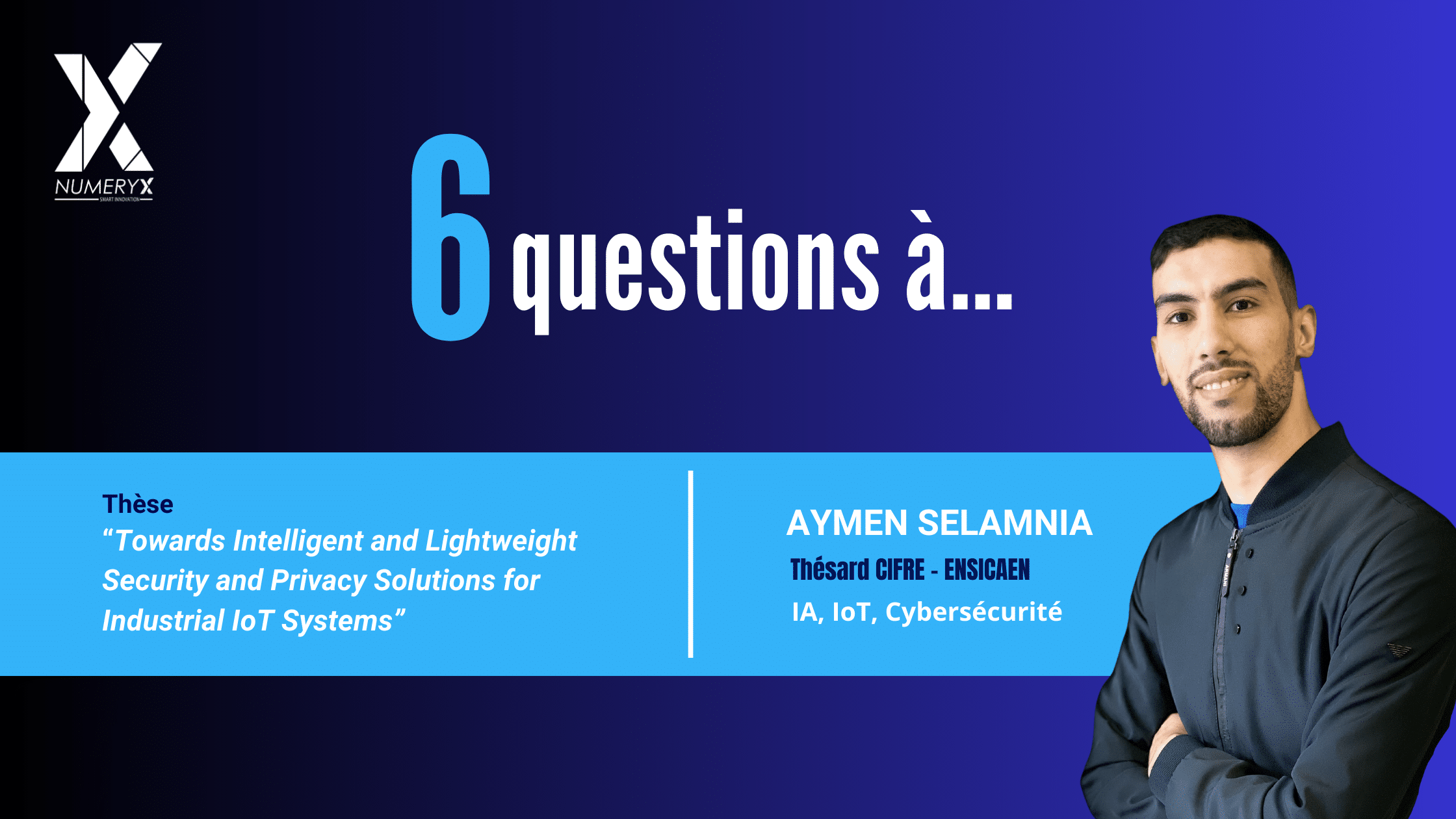
It is in this context that Aymene Selamnia, a PhD student supported by Numeryx and the University of Caen Normandy, defended his thesis entitled:
“Towards Intelligent and Lightweight Security and Privacy Solutions for Industrial IoT Systems”.
An ambitious piece of research with a clear promise: to reinvent intrusion detection systems (IDS) to make them more lightweight, intelligent, distributed and even… quantum.
II. Why current cybersecurity solutions are no longer enough
For a long time, traditional intrusion detection systems (IDS) fulfilled their role: monitor, alert, block. But with the massive rise of IIoT, these solutions are now reaching their limits.
- Too heavy: they consume resources that industrial equipment cannot always provide.
- Too rigid: they struggle to keep pace with ever more varied and sophisticated threats.
- Too centralised: they create a single point of failure that itself becomes a target.
- Too intrusive: they sometimes require sharing sensitive data, at the expense of confidentiality.
So instead of being a solid rampart, these tools sometimes become a burden. And in an environment where a single flaw can paralyse a factory, cut an energy network or endanger human lives, this is simply unacceptable.
On top of that comes a major problem: most IIoT equipment is not designed with security from the outset. Off-the-shelf devices are often deployed with no built-in cybersecurity solution, making them easy targets.
That is why it is time to rethink industrial cybersecurity with lighter, smarter, more distributed solutions that above all can adapt to attacks in real time.
Four advances that redefine intrusion detection
- A lightweight and efficient IDS
First step: design a protection mechanism able to block frequent attacks such as DoS and DDoS without overloading industrial equipment.
The idea is to provide a simple but robust defence, adapted to the constraints of sensors and connected devices, which often lack built-in security.
2. When AI learns continuously to anticipate threats
The second advance introduces artificial intelligence able to learn continuously and adapt to new threats.
Rather than a fixed system, it is an evolving process that becomes more reliable over time, taking into account its own level of confidence. A way to improve the accuracy and robustness of attack classification.
3. The strength of the collective: distributed detection with Split Federated Learning (SFL)
The third innovation aims to move to a decentralised approach with Federated Learning, but in a “split” version to adapt to IIoT constraints.
Thus, data stays local (offering better confidentiality and reducing network overload), while learning is shared, enabling better protection at scale.
4. The quantum era: towards more powerful and expressive hybrid systems (QSFL)
Finally, the culmination of the approach is to integrate quantum computing into the IDS.
Thanks to quantum encoding and variational circuits, the IDS becomes more expressive, faster and more efficient at handling the complexity of IIoT flows.
A first step towards hybrid quantum–classical systems able to push current limits.
IV Concrete results that open new perspectives
Aymene’s thesis is not just academic work: it outlines a progressive and coherent evolution of cybersecurity applied to IIoT.
Each contribution marks a step forward:
- first, a lightweight IDS able to counter DoS/DDoS attacks without overloading systems,
- then, an adaptive pipeline that learns continuously and strengthens classification reliability,
- next, a distributed architecture that protects confidentiality while improving scalability,
- finally, a quantum dimension that pushes the limits of speed and expressiveness.
These results are more than a series of innovations: they form a concrete roadmap for evolving industrial cybersecurity, reconciling performance, agility and respect for field constraints. A trajectory that reflects the very evolution of IIoT, moving from constrained, centralised systems to distributed, intelligent and hybrid environments.
V. Why this research matters for the future of Industry 5.0
Industry 5.0 (insert here a link to our white paper: https://www.numeryx.fr/actualites/livres-blancs/livre-blanc-comment-lindustrie-5-0-redefinit-elle-les-relations-entre-lhomme-la-machine-et-lenvironnement/ ) is not just about more automated factories. It rests on a subtle balance between artificial intelligence, human-machine collaboration and hyperconnected infrastructure. But the more powerful these systems become, the more vulnerable they get.
This is where this work takes on its full importance. It gives manufacturers a new defence framework, able to anticipate attacks rather than merely suffer them while adapting continuously to emerging threats. But it goes further by making it possible to respect the confidentiality of critical data, and even to harness quantum to anticipate the growing complexity of cyberattacks.
In short: this research is not about the distant future, it is about what companies must put in place today to secure the transition to Industry 5.0.
VI. NUMERYX, a committed partner of researchers and a catalyst for innovation
This work illustrates once again the ability of Numeryx and its researchers to anticipate major technological challenges.
By supporting this research, Numeryx affirms its commitment to developing cutting-edge expertise in IIoT cybersecurity and to training talent able to innovate by combining artificial intelligence, federated learning and quantum technologies.
It is also a concrete way of contributing to securing critical infrastructure, not only in France but worldwide.
VII. The IDS of the future is being written today
Securing IIoT is not just a technical challenge. It is a quest for constant balance: between performance and lightness, between confidentiality and collaboration, between innovation and real deployability.
Aymene Selamnia’s thesis perfectly illustrates this path. Starting from lightweight solutions, then adaptive ones, before moving to distributed and finally quantum, it shows how each step prepares the next. It is a methodical progression, but also a clear vision: that of cybersecurity able to grow at the same pace as Industry 5.0.
More than academic research, this work opens concrete prospects for industrial companies. It shows that tomorrow’s cybersecurity cannot be improvised: it is built today, step by step, constantly pushing the limits to better protect what matters.